How to Fix a Toilet That Keeps Running or Won’t Flush
Last updated: October 2026 · By Tony T. Johnson
Quick answer: Most toilet problems are fixed inside the tank:
- Toilet keeps running: usually a worn flapper, a chain that is too short, or a float set too high, so water spills into the overflow tube.
- Toilet will not flush: usually a loose or broken chain or handle, a low tank water level, or a clog.
Lift the tank lid, flush, and watch what happens. That tells you which part to adjust or replace.
Toilet repairs are among the easiest plumbing jobs. Replacement parts are cheap and standardized, and you rarely need more than your hands, a sponge and an adjustable wrench.
| At a glance | |
|---|---|
| Time | 5 minutes (adjustments) to 45 minutes (fill valve or flapper replacement) |
| Difficulty | Easy |
| Tools | Rubber gloves, sponge, towel, adjustable wrench, flathead screwdriver, food coloring (for the leak test) |
| Parts | Flapper (2-inch or 3-inch), universal fill valve, or a flush handle, depending on the fault |
How a toilet tank works (60-second version)
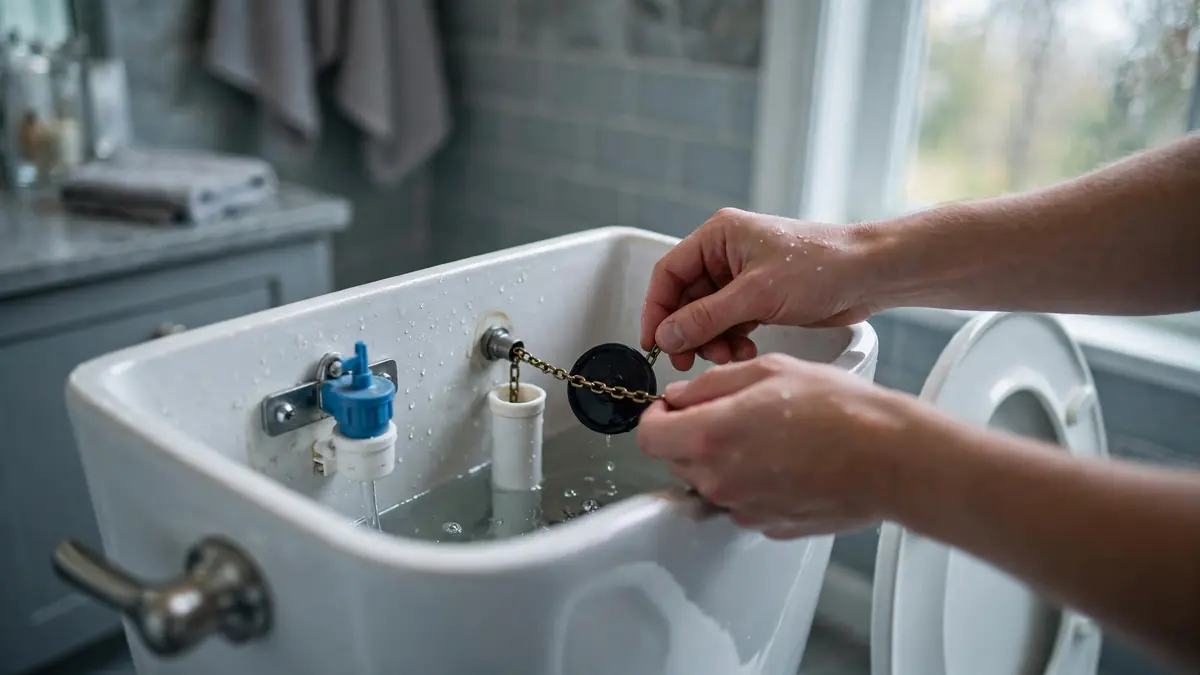
- You push the handle. It lifts a chain, which pulls up the flapper (the rubber seal at the bottom of the tank).
- Tank water rushes into the bowl and starts a siphon that empties the bowl.
- The flapper drops back onto the flush valve seat and seals.
- The float drops, opening the fill valve, which refills the tank. A thin refill tube sends some water down the overflow tube to refill the bowl.
- When the float rises to the set level, the fill valve shuts off.
Some toilets use a canister flush valve (a tall cylinder that lifts) instead of a flapper. The repair is similar, but the part is a canister seal rather than a flapper.
Diagnose your toilet in 60 seconds
Take the tank lid off, set it on a towel (it is heavy and breaks easily), and flush.
| What you see | Problem | Go to |
|---|---|---|
| Water keeps trickling over the top of the overflow tube | Water level set too high / fill valve not shutting off | Fix 2 or Fix 3 |
| Water level is below the overflow tube, but the tank keeps refilling every so often (phantom flush) | Flapper or seal leaking into the bowl | Fix 1 |
| Hissing, and the fill valve never stops | Worn fill valve | Fix 3 |
| Handle moves but nothing happens | Chain disconnected or broken, or broken handle arm | Fix 5 |
| You must hold the handle down to flush fully | Chain too long, or a waterlogged flapper | Fix 5 / Fix 1 |
| Bowl fills but does not empty (water rises, then slowly drains) | Partial clog or clogged jets | Fix 7, or see unclog a toilet |
| Weak flush, waste left behind | Low tank water, partly closed supply valve, clogged rim/siphon jets | Fix 6 / Fix 7 |
| Tank refills very slowly | Supply valve partly closed or debris in the fill valve | Fix 6 |
Part 1: Toilet keeps running
A running toilet is not just noise. EPA WaterSense estimates a leaky toilet can waste about 200 gallons of water a day.
Fix 1: Check and replace the flapper (the most common fix)
The dye test: put a few drops of food coloring in the tank, do not flush, and wait 15-30 minutes. If color appears in the bowl, the flapper or seal is leaking.
Replace the flapper:
- Turn off the water at the shut-off valve behind the toilet (clockwise) and flush to empty the tank.
- Unhook the chain from the handle arm.
- Slide the flapper’s ears off the pegs on the sides of the overflow tube (or cut and remove a ring-style flapper).
- Wipe the flush valve seat (the ring the flapper sits on) with a sponge or fine scrub pad to remove mineral buildup. A rough seat makes even a new flapper leak.
- Fit the new flapper. Match the size: most toilets use 2-inch flappers, while many newer high-efficiency toilets use 3-inch. Check the opening or the toilet’s model number.
- Attach the chain (see Fix 5), turn the water on and test.
Bring the old flapper to the store, or note the brand and model stamped inside the tank. Some brands use proprietary flappers or canister seals, and a universal flapper will not seal them well.
Fix 2: Adjust the float so the water stops below the overflow tube
If water flows over the top of the overflow tube, the float is set too high.
- Float cup (a cylinder on the fill valve shaft): squeeze the clip or turn the adjustment screw to lower the cup.
- Float ball (a ball on a horizontal rod, on older ballcock valves): turn the adjustment screw on top of the valve, or very gently bend the rod down a little.
Target water level: follow the water line mark inside the tank. If there is no mark, set it about 1 inch below the top of the overflow tube.
Real question from a forum: “How do I fix a running toilet with a ball float?” Lift the float arm by hand. If the water stops, lower the float slightly using the adjustment screw on the valve, or bend the arm gently downward. If the ball has water inside it (it sloshes or sits low), replace the ball. If the old ballcock still hisses after adjusting, replace it with a modern universal fill valve.
Fix 3: Replace the fill valve
If the fill valve hisses, refills constantly or will not shut off even with the float lowered:
- Turn off the water and flush. Sponge out the remaining water.
- Put a towel down, then disconnect the supply line under the tank.
- Unscrew the plastic locknut under the tank and lift the old valve out.
- Insert the new universal fill valve. Adjust its height so the critical level mark (or “CL”) is at least 1 inch above the top of the overflow tube. Check the instructions.
- Hand-tighten the locknut plus a quarter turn. Overtightening can crack the tank.
- Reconnect the supply line, clip the refill tube to the overflow tube (it should not go down inside the tube below the water line), turn on the water and set the float level.
Tip: before replacing a fill valve, try flushing debris out of it. With the water off, remove the cap (usually a quarter turn), hold a cup over the opening, and turn the water on briefly to blow out grit.
Fix 4: Check the refill tube
If the refill tube pushes too far down into the overflow tube, it can siphon water out of the tank continuously. Clip it so its end sits above the overflow tube opening.
Part 2: Toilet will not flush (or flushes weakly)
Fix 5: Fix the chain and handle
Chain length: with the flapper closed, leave about 1/2 inch of slack.
- Too tight: the flapper cannot seal, so the toilet runs.
- Too loose: the flapper does not lift enough, giving a weak flush or none at all, or you have to hold the handle down.
Loose handle: tighten the nut inside the tank that holds the handle. It is often a reverse (left-hand) thread, so turn it counterclockwise to tighten. A cracked handle arm means a new handle, which is a 5-minute swap.
Fix 6: Make sure the tank fills to the right level
A low water level gives a weak flush.
- Make sure the shut-off valve is fully open (counterclockwise). It often gets left half-closed after a repair.
- Raise the float so the water reaches the fill line.
- If the tank fills slowly, flush the debris out of the fill valve (Fix 3 tip), or replace it.
Fix 7: Clean the rim jets and siphon jet
Hard water leaves mineral deposits in the small holes under the bowl’s rim and in the larger siphon jet hole at the bottom front of the bowl. Blocked jets mean weak, slow flushes.
- Shine a mirror and flashlight under the rim. Crusty, partly blocked holes are the giveaway.
- Poke each rim hole with a piece of stiff wire or a small Allen key.
- For heavy buildup: turn off the water, flush, and dry the rim with a towel. Then seal the rim holes with plumber’s tape or duct tape, pour white vinegar into the overflow tube so it runs down to the jets, and leave it overnight. Remove the tape and scrub.
- Clear the siphon jet with the wire, then flush a few times.
Fix 8: Check for a clog
If the bowl fills up and drains slowly, there is a partial clog in the toilet’s trap-way or the drain. Use a flange plunger or a toilet auger. See our full guide: how to unclog a toilet.
Real question from a forum: “After using the toilet auger it flushes fine, then clogs again. Why?” Common reasons: something solid is stuck in the trap-way (a toy, a cap, a brush head) that the auger only pokes past; a partial blockage further down the drain line; a blocked roof vent; or an older toilet with weak flush performance. If a hard object is suspected, the toilet needs to come off so it can be removed from below.
Real question from a forum: “Our toilets will not flush when the ground is soaked after rain. We have a septic system.” That is usually a saturated or failing drain field. The water has nowhere to go, so the system backs up. Cut water use during wet periods and have a septic professional inspect the tank (it may need pumping) and the drain field. Gutters or surface water draining onto the field make it worse.
Other common toilet problems
| Problem | Likely cause | Fix |
|---|---|---|
| Water on the floor around the base | Failed wax ring | Replace the wax ring (the toilet has to come off) |
| Water dripping from under the tank | Loose tank bolts, worn tank-to-bowl gasket, or a supply line leak | Tighten gently, or replace the gasket or supply line |
| Toilet rocks | Loose closet bolts or an uneven floor | Tighten the bolts gently and shim. Rocking can break the wax seal. |
| Sweating tank | Cold water meeting humid air | Insulate the tank, or use a tank liner or mixing valve |
| Gurgling when other fixtures drain | Vent or main-line problem | Call a plumber |
Repair or replace the toilet?
Repair if the problem is a flapper, fill valve, handle, chain or wax ring. These are inexpensive parts. Consider replacing the toilet when:
- the bowl or tank is cracked (a crack can fail suddenly and flood),
- it is an old 3.5-gallon or larger model and you want to save water (WaterSense toilets use 1.28 gallons per flush or less),
- it clogs constantly even with nothing wrong in the drain,
- or parts for an unusual design are no longer available.
When to call a plumber
- Water leaking into the ceiling below
- Several fixtures backing up or gurgling
- A cracked bowl or tank
- A corroded shut-off valve that will not turn or leaks. Forcing it can break it.
- Septic system concerns
FAQs
Why does my toilet keep running?
Most often, the flapper is worn and leaks water into the bowl, or the float is set too high so water spills into the overflow tube. A chain that is too tight, a failing fill valve or a refill tube pushed too far into the overflow can also cause it.
How do I stop my toilet from running?
Lift the tank lid and check the water level. If water flows over the overflow tube, lower the float. If not, do a food-coloring dye test. Color in the bowl means you should replace the flapper and clean the flush valve seat.
Why will not my toilet flush?
The usual causes are a disconnected or loose chain, a broken handle, a tank water level that is too low, a partly closed supply valve, clogged rim or siphon jets, or a clog in the toilet or drain.
Why does my toilet fill with water but not flush?
The bowl rises because water cannot leave fast enough. That is usually a partial clog in the trap-way or drain line, or weak siphon action from clogged jets or a low tank level. Plunge or auger first, then clean the jets.
How much does it cost to fix a running toilet?
Doing it yourself, the part is usually a flapper or a universal fill valve, both inexpensive at hardware stores. A plumber’s visit costs more because of call-out and labor fees. Most running toilets are fixable in under an hour.
What is a phantom flush?
It is when the toilet briefly refills on its own without anyone flushing. Water is slowly leaking from the tank into the bowl, usually past a worn flapper or a dirty flush valve seat. A dye test confirms it.
How long should the chain be on a toilet flapper?
Leave about half an inch of slack when the flapper is closed. Too tight keeps the flapper from sealing. Too loose gives a weak flush.
Do I need to turn off the water to fix a toilet?
For adjustments like the chain or float, no. To replace a flapper, fill valve or supply line, turn the shut-off valve behind the toilet clockwise and flush to empty the tank first.
Sources and standards
- U.S. EPA WaterSense: Fix a Leak, and toilet leak guidance (dye test, water waste estimates)
- U.S. EPA WaterSense: specification for tank-type toilets (1.28 gpf)
- Toilet and fill valve manufacturer installation instructions (critical level, refill tube placement)
About the author: Tony T. Johnson, founder and lead editor of HomeRevampDaily.