How to Replace a Door Handle (and Fix a Loose Doorknob)
Last updated: October 2026 · By Tony T. Johnson
Quick answer: To replace a door handle, remove the two screws on the inside rose (or press the hidden detent and pull the knob off), pull both handles apart, then unscrew and remove the latch from the door edge. Install the new latch with its angled side facing the door frame, slide the handles through, tighten the screws evenly and test before closing the door.
This guide covers interior and exterior house door knobs and levers (not car or appliance handles). It also covers the second most common door-handle problem: a loose doorknob that wobbles or keeps falling off.
| At a glance | |
|---|---|
| Time | 15-30 minutes |
| Difficulty | Easy |
| Tools | Phillips screwdriver, flathead screwdriver, tape measure, paper clip or small nail, utility knife (for painted-in hardware) |
| Cost | A new lockset only. A screwdriver is all most jobs need. |
Before you buy: 4 measurements that decide whether the new handle fits
Most standard US door handles are interchangeable, but check these before you shop. It saves a return trip (one expert tip that never gets old: bring the old latch to the store).
| Check | How to measure | Standard US size |
|---|---|---|
| Backset | From the door edge to the center of the big round hole | 2-3/8 in (most interior) or 2-3/4 in (many exterior). Most new latches adjust to both. |
| Cross bore (face hole) | Diameter of the big hole through the door face | 2-1/8 in |
| Edge bore | Diameter of the hole in the door edge for the latch | 1 in (some older doors use 7/8 in) |
| Door thickness | Measure the door edge | 1-3/8 in (interior) / 1-3/4 in (exterior). Most sets fit both. Thicker doors need a kit. |
Then choose the function:
- Passage: no lock (hallways, closets)
- Privacy: push-button or turn-button lock with an emergency release hole outside (bedrooms, bathrooms)
- Keyed entry: locks with a key (exterior doors, often paired with a deadbolt)
- Dummy: a fixed handle with no latch (closet pairs, the inactive side of French doors)
Levers have a direction. Some levers are “handed” (left or right) and will not sit level if installed on the wrong side. Most current levers are reversible. Check the box, and see “Lever points down after install” in the troubleshooting section below.
Real question from a forum: “Does a dummy knob just screw on if the door was not bored?” Yes. Most dummy knobs surface-mount with screws through a base plate, so you do not need a bored hole. If the door is bored, buy a “dummy” that is made to fill a 2-1/8-inch bore, or a through-bolted half-dummy designed for it.
How to remove a door handle (visible screws or hidden screws)
If you can see two screws on the inside rose
- Open the door and wedge it so it cannot swing.
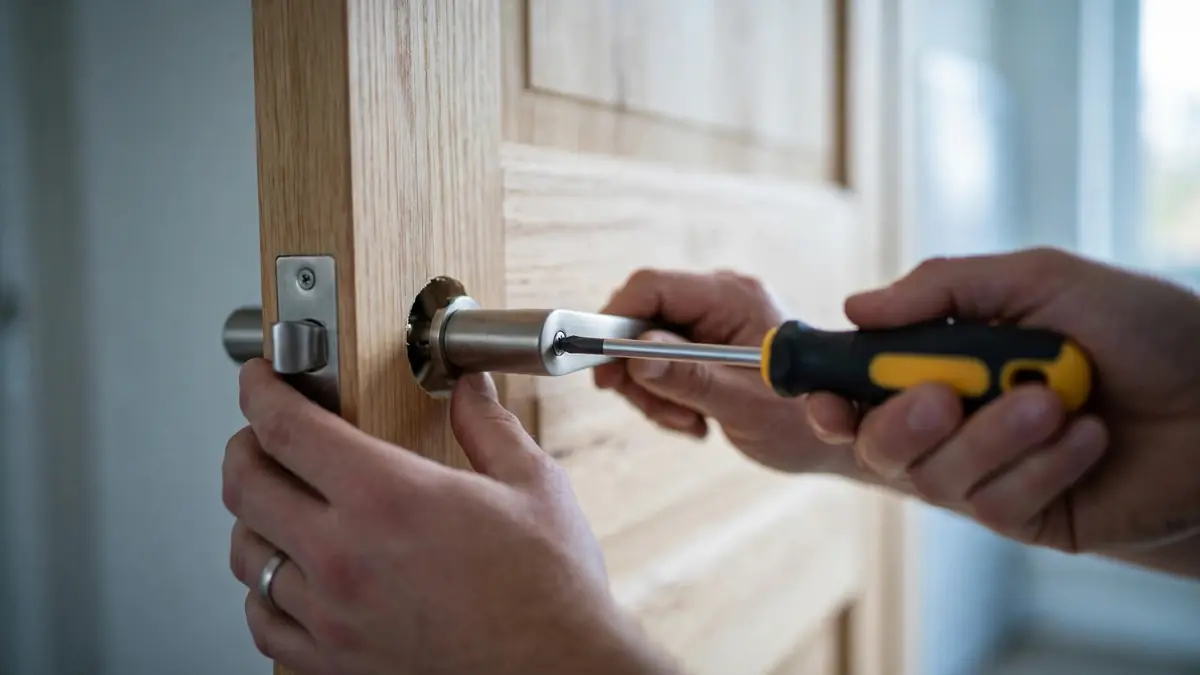
- Remove the two screws on the inside rose (the round or square plate against the door).
- Pull the two handles apart. The outside handle and its spindle slide out from the other side.
- Skip to “Remove the latch” below.
If you cannot see any screws (the most common problem)
Newer knobs and levers hide their screws under a decorative rose. Look closely at the neck of the inside handle and the edge of the rose:
- Find the detent. Look for a small slot or pinhole on the underside of the knob’s neck (the shank). On some models it is on the side of the lever neck.
- Release the handle. Push a paper clip, small nail or the tip of a flathead screwdriver into the hole or slot, press, and pull the handle straight off at the same time.
- Pop the rose. Look for a small notch on the rose edge. Insert a flathead screwdriver and gently pry. Some roses twist counterclockwise instead.
- Remove the exposed screws on the mounting plate and pull both halves apart.
Real question from a forum: “Both sides are identical, no screws anywhere. How do I get it off?” On many hidden-screw sets, the release is a tiny button or wire tab on the shank, and it only lines up when the knob is turned partway. Rotate the knob a quarter turn while you probe with a pin. On a privacy set, the inside half (the one with the push button) almost always holds the release.
Old knobs with a set screw (pre-1960s and mortise hardware)
Older knobs often slide onto a square metal spindle and are held by a small set screw in the knob’s neck. Loosen that set screw and the knob slides off the spindle. These knobs connect to a mortise lock (a box-shaped lock set into a pocket in the door edge), not a tubular latch. If you want to keep the old-house look, consider restoring the original hardware instead of replacing it. Clean it gently rather than stripping the patina.
Remove the latch and strike plate
- Remove the two screws on the latch faceplate in the door edge.
- Pull the latch out. If it is painted in, score around the faceplate with a utility knife first, then pry gently with a flathead. Do not yank. Old latches can be pressure-fit, and pulling hard can split the door edge.
- Unscrew the strike plate on the frame if your new set includes a new one (match the finish, and make sure the screw holes line up).
How to install a new door handle (step by step)
Step 1: Set the latch backset
Check the latch against your measured backset. Adjustable latches switch between 2-3/8 in and 2-3/4 in. You either rotate the faceplate or push and slide the barrel until it clicks, depending on the brand. A wrong backset is the number one reason the spindle will not engage.
Step 2: Install the latch the right way round
Slide the latch into the edge bore. The angled (beveled) side of the latch bolt faces the direction the door closes, toward the strike plate. If it is backward, the door will slam against the latch and will not latch.
Screw the faceplate in flush. If the faceplate sits proud, deepen the mortise slightly with a sharp chisel.
Step 3: Fit the exterior handle
From the outside, slide the handle with the long spindle and mounting posts through the latch. The posts pass through the holes in the latch body, and the spindle passes through the center slot. If the spindle will not go through, the latch is set to the wrong backset, or the spindle is rotated 90 degrees.
Step 4: Attach the interior handle
Line up the interior handle with the posts and spindle, push it on, and insert the screws. Tighten each screw a little at a time, alternating sides, so the handles pull in evenly and stay centered.
Step 5: Test before you close the door
With the door open, turn the handle both ways and test the lock function several times. The latch should snap out fully. Then close the door gently and test again.
Step 6: Install or adjust the strike plate
Screw on the strike plate. If the latch will not catch:
- Rub lipstick or a dry-erase marker on the latch tip and close the door. The mark shows where it hits the frame.
- Small misalignments (1/8 in or less): file the strike opening.
- Larger misalignments: move the strike plate, or tighten the top hinge screws (a sagging door is a common cause).
How to fix a loose doorknob or lever (without replacing it)
A wobbly handle almost always means one of five things. Work through them in order:
| Symptom | Cause | Fix |
|---|---|---|
| Whole handle wobbles; rose moves | Through-bolts have loosened | Tighten the two screws on the inside rose. On hidden-screw sets, pop the rose off and tighten the screws underneath. |
| Knob spins or slides off; rose is solid | Set screw on an old spindle-type knob has backed out | Tighten the set screw against the flat side of the spindle. Add a drop of removable (blue) threadlocker if it keeps loosening. |
| Knob keeps falling off one side | Worn or wrong-length spindle, or the screw is grabbing threads that have stripped | Replace the spindle, or fit spindle shims. If the knob is modern, replace the set. |
| Lever droops and does not spring back | Broken return spring inside the lever’s chassis | Some brands sell replacement springs or cartridges. Otherwise replace the set. |
| Latch faceplate rattles | Stripped screw holes in the door edge | Fill holes with wooden toothpicks or golf tees and wood glue, trim flush, and redrive the screws. Or use longer screws. |
Real question from a forum: “I reassembled my knob, but the rose will not line up with the screw holes.” The mounting plate under the rose has to rotate with the handle’s posts. Put the inside handle on first, turn it until the screw holes line up with the posts, then hold the outside handle steady while you start both screws by hand. Only snap the decorative rose on once the screws are tight.
Emergency fixes: locked doors and stuck latches
A child is locked inside with a privacy knob
Look for the small hole in the center of the outside knob or lever. Push a straight pin, small screwdriver or the emergency key that came with the set into the hole:
- Push-button privacy locks: push straight in until it releases.
- Turn-button privacy locks: you feel a slot. Turn it a quarter turn.
Keep the emergency key on top of the door frame.
The knob came off and the latch is stuck in the frame
- Put a flathead screwdriver into the square or slotted hole in the latch where the spindle used to go.
- Turn it the same way the handle normally turns. That pulls the latch bolt back.
- If the latch is jammed, slide a putty knife or a stiff plastic card between the door and the frame at the latch. Angle it toward the latch’s bevel and push while pulling the door.
Troubleshooting a new door handle
| Problem | Fix |
|---|---|
| Lever points down after install | It is handed. Swap sides, or follow the instructions to reverse the lever (often a small pin or clip). |
| Handle is stiff or does not spring back | Screws are overtightened and pulling the handles off-center. Back them off 1/4 turn, recenter, and tighten evenly. |
| Latch does not retract fully | Backset is wrong, or the latch is upside down. |
| Door will not stay shut | Strike plate is misaligned. Use the marker trick, or file the opening. |
| Key turns but does not unlock | Outside handle installed upside down, or wrong function. Check the instruction diagram. |
Replacing a sliding patio door handle
Sliding door handles are a different system. They are surface-mounted pulls that screw through the door stile and work a mortise latch inside the frame. Measure the screw hole spacing (center to center) on the old handle and the door thickness, then buy a handle with the same spacing. Most patio door brands sell matching replacements. Universal kits exist, but spacing must match.
When to call a locksmith or carpenter
- The door has a mortise lock you want to convert to a modern tubular set (it needs wood filling and new bores).
- The door edge is split around the latch.
- An exterior door needs a higher-security lockset with a reinforced strike.
- You are locked out of an exterior door with no other way in.
FAQs
Are all door handles the same size?
Most US tubular door handles fit a 2-1/8-inch cross bore and a 1-inch edge bore with a 2-3/8- or 2-3/4-inch backset, so new handles usually fit existing holes. Older mortise locks and some imported or commercial hardware use different sizes, so measure before buying.
How do I remove a door knob with no visible screws?
Find the small slot or hole on the knob’s neck, press it with a paper clip or small screwdriver, and pull the knob off. Then pry off the decorative rose at its notch to expose the mounting screws, remove them, and pull the two halves apart.
Why does my doorknob keep falling off?
The set screw or through-bolts keep loosening, usually because the screw grips a stripped thread or a worn spindle. Tighten the set screw against the spindle’s flat side with blue threadlocker, or replace the spindle. On modern sets, worn internal parts usually mean replacing the handle set.
Which way does the latch go on a door handle?
The angled, beveled side of the latch bolt faces the direction the door closes, toward the strike plate on the frame. The flat side faces away from the frame. If it is reversed, the door will not latch.
Can I replace a door knob with a lever handle?
Yes. Levers use the same 2-1/8-inch bore and standard latch. Check whether the lever is handed (left or right) or reversible, and confirm the backset. Levers are also easier for kids, older adults and anyone with limited grip strength.
How long does it take to replace a door handle?
About 15-30 minutes per door for a like-for-like swap with a screwdriver. Add time if the old hardware is painted in, the strike needs adjusting, or you are installing a deadbolt.
Do I need to replace the strike plate too?
Not always, but new sets include one in a matching finish. Replace it if the finish does not match, the old one is worn, or the screw holes do not line up with the new latch.
How do I tighten a door handle with hidden screws?
Remove the handle using the detent slot, pop the rose off at its notch, and tighten the two exposed mounting screws evenly. Snap the rose back on and reinstall the handle until it clicks into place.
Sources and standards
- Manufacturer installation instructions (Kwikset, Schlage, Defiant). Keep the sheet that comes with your set.
- BHMA / ANSI A156.2 (bored and preassembled locks and latches): defines grades 1-3 for residential and commercial durability
- Door preparation standard dimensions for tubular locksets: 2-1/8 in cross bore, 1 in edge bore, 2-3/8 / 2-3/4 in backset
About the author: Tony T. Johnson, founder and lead editor of HomeRevampDaily.